

Bayern Munich wins approximately 75-85% of their Bundesliga matches in any given season. That sounds like easy money until you realize that bookmakers price their victories at odds so short that a single unexpected result wipes out weeks of accumulated profits. The fundamental challenge of betting on Bayern isn’t predicting whether they’ll win — it’s determining whether the odds offered represent genuine value or an elaborate trap designed to separate recreational bettors from their bankrolls.
The Bavarian giants have claimed 34 German championship titles — 33 in the Bundesliga era — including 12 in the last 13 seasons before Bayer Leverkusen’s historic 2023-24 triumph briefly interrupted their dominance. They promptly reclaimed their throne in 2024-25, reminding everyone that betting against Bayern’s domestic supremacy remains a fool’s errand. Yet this predictability creates its own peculiar betting dynamics. When a team wins with such monotonous regularity, the real edge doesn’t come from backing them blindly — it emerges from understanding the specific situations where their odds misrepresent actual probability, and equally importantly, recognizing when those prohibitive prices offer no value whatsoever.
The Mathematics of Backing Heavy Favorites
Consider the cold arithmetic that governs Bayern betting. When bookmakers price Bayern at -400 (1.25 decimal), they’re implying an 80% win probability. To profit long-term at these odds, Bayern needs to win approximately 80% of the time. Sounds reasonable given their historical dominance, except the margin for error effectively disappears. A single draw against a stubborn mid-table opponent, or a shock defeat to a relegation candidate riding a wave of desperate motivation, doesn’t just cost you one bet — it erases the profits from four or five previous winners.
The house favorite trap catches countless bettors who conflate “likely to win” with “good betting value.” Bayern hosting Heidenheim probably will win. They’ll dominate possession, create numerous chances, and their squad depth alone outclasses most Bundesliga opponents. But if bookmakers offer -500 odds on that outcome, you’re laying 500 to win 100, requiring an 83% success rate just to break even. Bayern’s actual win rate hovers closer to 75-80% across full seasons, meaning straight match-winner betting at extreme short prices guarantees long-term losses through pure mathematical inevitability.
The psychological comfort of backing overwhelming favorites costs more than most recreational bettors comprehend. There’s something seductively reassuring about wagering on a team that “can’t lose” against apparently inferior opposition. That comfort becomes expensive the moment reality intervenes. Bayern lost or drew roughly 20-25% of their matches across recent seasons — not because they faced seventeen Bayern-quality opponents, but because football contains irreducible randomness that even elite teams cannot eliminate entirely.
Alternative Markets That Actually Offer Value
The profitable approach to Bayern betting abandons straight match-winner markets in favor of specific propositions where their dominance translates into genuinely mispriced odds. Asian handicap betting levels the playing field through goal head-starts that bookmakers sometimes price inefficiently. Bayern at -1.5 goals against a bottom-half opponent offers more reasonable returns than backing them to simply win, while maintaining significant expected profit when they secure the routine 3-0 or 4-1 victories that characterize their home fixtures.
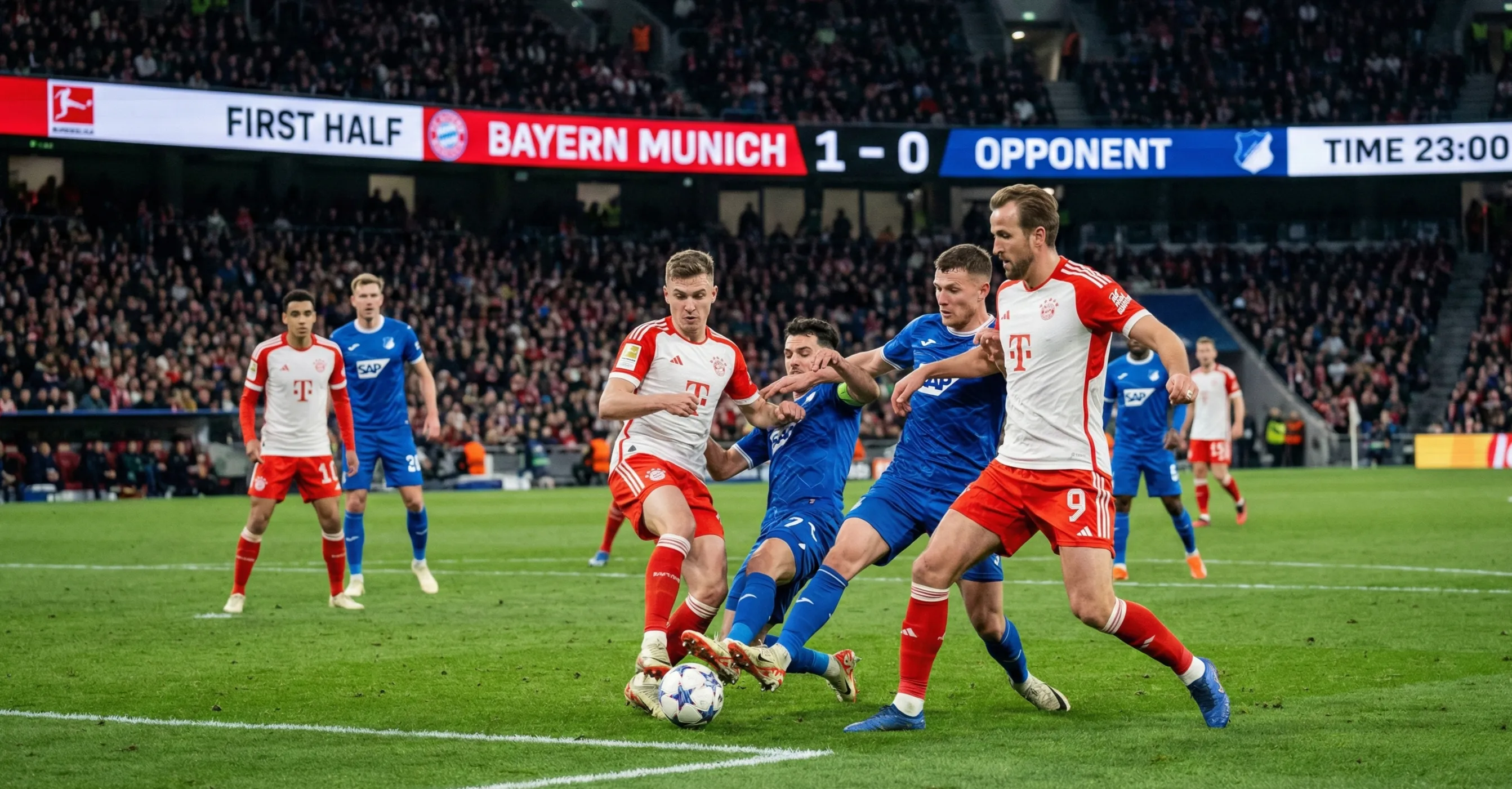
First-half betting capitalizes on Bayern’s tendency to impose themselves immediately on weaker opposition. Under Vincent Kompany, Bayern have frequently established early control, scoring in the opening 45 minutes with remarkable consistency. Backing Bayern to lead at halftime often comes at odds closer to evens or slight favorites rather than the prohibitive -400 territory of full-time results. If your analysis suggests Bayern will dominate from kickoff — which against relegation candidates at the Allianz Arena remains a reasonable expectation — the first-half market concentrates your edge into a shorter timeframe with better risk-reward balance.
Team totals present another avenue where Bayern’s attacking firepower creates exploitable value. Rather than predicting whether Union Berlin might snatch a 1-1 draw through defensive discipline and a fortunate counter-attack, backing Bayern to score over 2.5 goals isolates their offensive production from opponent performance. Harry Kane’s presence virtually guarantees consistent goal threats, and the supporting cast of Musiala, Olise, and company provides multiple scoring avenues that bottom-half defenses simply cannot contain across ninety minutes.
The logic extends to player propositions, particularly goalscorer markets. Kane to score anytime typically prices around -120 to -150, reflecting his near-certainty of getting scoring opportunities against outmatched opposition. When Bayern face teams that will inevitably concede territorial dominance, Kane’s penalty-taking duties and elite positioning make anytime goalscorer bets considerably less speculative than they might appear at similar odds for strikers at clubs with less attacking dominance.
Research safely the mid table teams.
Situational Factors That Create Genuine Value
Bayern’s vulnerabilities emerge in specific contexts worth tracking obsessively. Matches immediately following Champions League fixtures, particularly after demanding encounters against elite European opposition, frequently see rotation and reduced intensity. When Bayern travels to Porto on Tuesday and hosts Freiburg on Saturday, the domestic fixture carries meaningful probability reductions that bookmakers don’t always fully price into their odds.
Late-season matches after Bayern has mathematically secured the title present another exploitable scenario. Once championship destiny becomes certainty — often occurring by March in dominant campaigns — motivation inevitably decreases while experimental lineups increase. These matches rarely attract the same Bayern that pursued maximum points throughout autumn and winter. Backing opponents at inflated underdog odds during Bayern’s victory lap occasionally offers genuine value, though selectivity remains essential.
The winter break creates a third situational opportunity. German football pauses mid-December through mid-January, and form often resets upon resumption. Teams that struggled before the break return refreshed, while those riding hot streaks may cool considerably. Bayern typically maintains quality across this transition better than most, but the post-break period introduces form uncertainty that careful analysis can exploit before bookmakers fully adjust their assessments.
Pre-season and early-season matches under new management represent rare windows where Bayern actually faces legitimate uncertainty. When Kompany arrived, questions surrounded his tactical approach and ability to manage elite egos. Those first few fixtures carried genuine unpredictability that evaporated once his methods proved effective. Recognizing these transitional moments — and having the courage to fade Bayern when evidence suggests genuine dysfunction rather than temporary adjustment — separates sophisticated bettors from those who assume Bayern invincibility regardless of circumstances.
What the Statistics Actually Tell Us
Bayern’s defensive record matters enormously for betting purposes despite receiving less attention than their prolific attack. They conceded just 17 goals in their record-setting 2015-16 campaign and consistently maintain defensive stability that impacts both teams to score markets and total goals calculations. Their defensive solidity makes BTTS a riskier proposition in Bayern matches than league-wide averages suggest — opponents frequently fail to find the net against Bayern’s organized back line, particularly at the Allianz Arena.

The xG differential between Bayern and Bundesliga opponents illuminates their comprehensive dominance beyond simple scorelines. Bayern typically generates expected goals around 2.5-3.0 per match while limiting opponents to 0.8-1.0 xG — a gap that regression analysis suggests is remarkably stable and process-driven rather than luck-dependent. This statistical foundation supports systematic approaches to Bayern betting rather than game-by-game speculation.
Historical head-to-head records reveal persistent matchup dynamics worth incorporating into analysis. Certain clubs consistently trouble Bayern despite overall quality gaps — perhaps tactical styles create exploitable mismatches, or psychological factors accumulated across multiple seasons affect performance beyond what current form suggests. When Mainz or Köln visit Munich and covers spreads at rates exceeding what their league position predicts, pattern recognition identifies potential edges that pure form analysis misses.
Building a Sustainable Bayern Betting Strategy
Discipline distinguishes profitable Bayern betting from expensive entertainment. The temptation to back Bayern in every match because they’re “obviously” better must be resisted systematically. Not every Bayern fixture offers value worth exploiting, and sometimes the optimal bet is no bet at all. Waiting for situations where odds genuinely misrepresent probability — rather than betting simply because Bayern exists — compounds into meaningful advantage across a full season.
Stake sizing requires particular attention given the compressed odds typical of Bayern markets. Standard bankroll management suggests risking 1-2% per bet, but the practical reality of laying -400 or worse changes effective bankroll exposure considerably. Backing Bayern at -400 with a 2% stake requires a 2% bankroll commitment to win 0.5% — the risk-reward ratio differs fundamentally from betting +200 underdogs where 2% wins 4%. Adjust expectations and stake calculations accordingly rather than applying generic betting rules without modification.
Line shopping across multiple bookmakers becomes mandatory rather than optional when dealing with compressed Bayern odds. The difference between -380 and -420 might seem negligible, but across a season of consistent betting, those marginal improvements accumulate into substantial bankroll impact. Maintaining accounts at multiple sportsbooks and checking comparison sites before every Bayern wager represents fundamental best practice that recreational bettors frequently ignore.
Record-keeping enables objective evaluation of your Bayern betting approach. Track not just wins and losses but the specific market types, situational factors, and closing line value of each wager. Did you consistently beat closing odds? Did certain market types outperform others? Did situational factors like Champions League scheduling actually predict reduced Bayern performance? Data-driven refinement replaces gut-feeling gambling with systematic improvement over time.
Bayern Munich will continue dominating German football for the foreseeable future. Their financial resources, institutional excellence, and player recruitment advantages virtually guarantee perpetual competitiveness at the domestic level. But dominance on the pitch doesn’t automatically translate into betting profitability — that requires understanding when odds reflect reality, when they overcompensate for perceived certainty, and when specific markets offer genuine edge despite prohibitive headline prices. The sophisticated bettor doesn’t ask whether Bayern will win. They ask whether the available odds make backing them mathematically sensible.
Start constantly winning rapidly working at bundesliga bet.
